What’s a light year?
When speaking about space and the universe, a term that often comes up is a “light year.” For those not familiar with astronomy, the term itself can be confusing. That’s because a light year is a measurement of distance, not of time.
The concept of a light year is simple enough to understand: One light year is the distance light travels in 365 earth days.
Going back to grade 9 science, you’ll recall that the basic formula to calculate distance is Distance = Velocity (Speed) * Time, or D = V * T.
So using that formula, we can easily figure out how far a light year is.
We know a light goes approximately 300,000 km per second. (Not exactly—it’s actually 299,792.458 km/s, but hey, 300,000 is close enough!)
We also know there are 31,536,000 seconds in a (non-leap) year.
So: Distance = Velocity [300,000 km/s] times Time [31,536,000 seconds] = 9,460,800,000,000. That’s 9.46 trillion for those who have trouble counting zeroes. Therefore: a light year is 9.46 trillion kilometres.
Ok, that’s the easy part. The math is simple. We plug in our numbers and voila! We have a number—a really big number—but a recognizable number nonetheless.
But here’s where it gets hard. It is one thing to understand what a light year is; it is quite another to comprehend what a light year is. Indeed, I’d argue that even though we can understand the math behind a light year very easily, we simply have no human frame of reference to comprehend how large that distance is. But let’s try…
Let’s think about the distance of a light year in terms of the size of our solar system, which we know is very large.
Radio waves go nearly the speed of light in a vacuum. This explains why when the lunar crews were communicating with us earthlings, there was about two seconds of delay between transmissions. The moon is about 384,000 km from us, so the radio wave took just over a second to get there, and another second for the answer to get back to us. Keep in mind, it took the astronauts about 3 days to get to the moon going about 10 km/second. That’s pretty fast!—about 36,000 km/hour.
But a light second (or two) is a far cry from a light year.
The sun is much, much further from us than the moon. It’s about 150 million kilometres from us. Since light (only) travels 300,000 km/second, it takes about 8 minutes for the sunlight to get to us. That means that if the sun stopped shining right now, we wouldn’t know about it for 8 minutes when everything would go dark.
But 8 minutes is still very short of a year. We’re going to have to stretch much further into our solar system to get close to a light year.
There are two human-made objects that have gone further to the edges of our solar system than anything else: the Voyager 1 & 2 spacecraft that were launched in September 1977. Voyager 1 is now, as of writing this, about 22.4 billion kilometres away. It takes a radio signal about 20.5 hours to reach it by now (or vice versa). (There’s interesting constantly updated data on the Voyager 1 and 2 spacecraft here.) That’s a mind-bending amount of time. That means that any instruction the earthbound controllers want to send to the spacecraft takes almost a full day to send and a full day to receive confirmation about whether the signal was received.
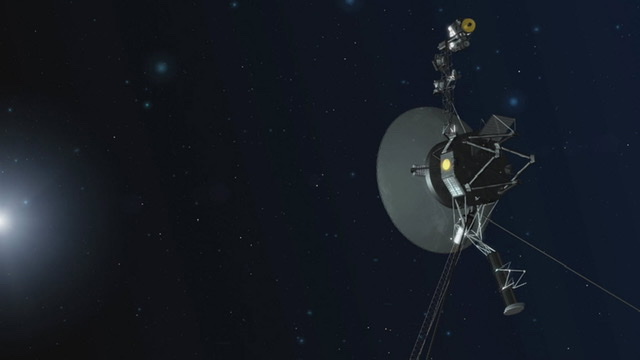
However: We’ve only managed to stretch out to one light DAY.
Do you remember how much we said a light year is? It is 9.46 TRILLION kilometres! That means that the Voyager spacecraft, launched some 43 years ago, is only about 0.02% of the way toward reaching its first light year! At this rate, Voyager will reach the distance of one light year from earth in a mere 18,159 years from now. (Don’t bother marking your calendars…)
If your brain doesn’t hurt yet, hang on. Other than the Sun, the nearest star to us—Alpha Centauri— is about 4 light years away. The Voyager is travelling about half a billion kilometres a year. Assuming it is heading on a trajectory toward Alpha Centauri, Voyager will need another 75,640 years (give or take a few depending on whether it takes a washroom break) to get there at its current rate!
The vast distances of a light year are already mind boggling. However, relative to the size of the universe, a light year is actually minuscule. Although no one really knows for sure, astronomers estimate that the universe is about 93 billion light years across. How many kilometres is that?
Well, let’s do the math.
93 billon (width of universe) times 9.46 trillion (Distance of one light year) equals 879,700,000,000,000,000,000,000 kilometres, or 8.797 x 10 to the power of 23.
Let’s just admit that the concept of a light year is easy to understand mathematically. But the distance of a light year, let alone the span of the universe, is simply beyond our ability to comprehend. We have nothing we can even compare these numbers to in our human experience and so it is, finally, almost meaningless to our brains to say that the universe is 93 billion light years across. We really don’t even know what that means.
My favourite theologian, Karl Barth, was highly sceptical that we could deduce truth about God on the basis of observation of nature, a.ka. Natural theology. Those who do think that nature can tell us something about God would say that the size of the universe, specified as we do in light years, tells us about the immensity and grandeur of God. Perhaps.
But even if it does, we have no ability to understand the God who created and sustains this universe. Billions and trillions barely make sense to our minds, let alone 1’s with 23 zeroes behind it. Indeed, we can’t really deduce anything about the God who made this universe precisely because of the limits of our own human reasoning. Sure, we can see he is awesome and majestic and we might even call him infinite or incomprehensible. But those words are just negations–telling us what God is not. Not finite, not comprehensible. That kind of information doesn’t really reveal anything about who God is, let alone what he is like.
This is also why Barth, in his famous commentary on Romans, insisted that there is an infinite qualitative difference between God and us. Not an infinite quantitative difference. God’s nature is not measured as being simply BIGGER or MORE than the universe. He is not a creature multiplied to the power of infinity. Rather, he is so completely different from us that even if we were to comprehend the size of a light year or the magnitude of the universe, we could not comprehend God as a logical extension of that knowledge.
But here is the amazing, mind-bending truth.
The infinitely and qualitatively different God who created these immense light year distances has made himself known to us. And we have come to known him as he condescended to us, took on human flesh, and gave himself the name Jesus, Immanuel, God with us.
And that is something, my friends, no genius using a mathematical formula or calculator or supercomputer could ever figure out on her or his own.
“And the light shineth in darkness; and the darkness comprehended it not.” ( John 1:5 – KJV)
 David Guretzki, PhD